If you own a business and you are in your mid-fifties or older, estate questions often move up the list. Capital gains tax can hit hard when shares or other assets pass on death. A sale, a family handoff, or a buyout can each require cash at the right time. Probate can also add fees, delays, and a public record in provinces where it applies.
Segregated funds will not solve all of that on their own. Used carefully, though, they can help. A death benefit guarantee can set a floor under estate value, and on many contracts, optional resets can step up that floor after markets rise. On a personal contract set up correctly, a named beneficiary can help bypass probate in many provinces. Each of these depends on the product, the contract setup, fees, and your circumstances.
A segregated fund is an insurance contract that holds investments you choose. Most contracts include a maturity guarantee, often at least 75% of deposits (adjusted for withdrawals) after a long hold, and a death benefit guarantee that generally pays your beneficiaries the greater of the market value and the adjusted guarantee.
Percentages, fees, and rules vary by product, and higher guarantees often come with higher fees. Market value can still fall while you are alive.
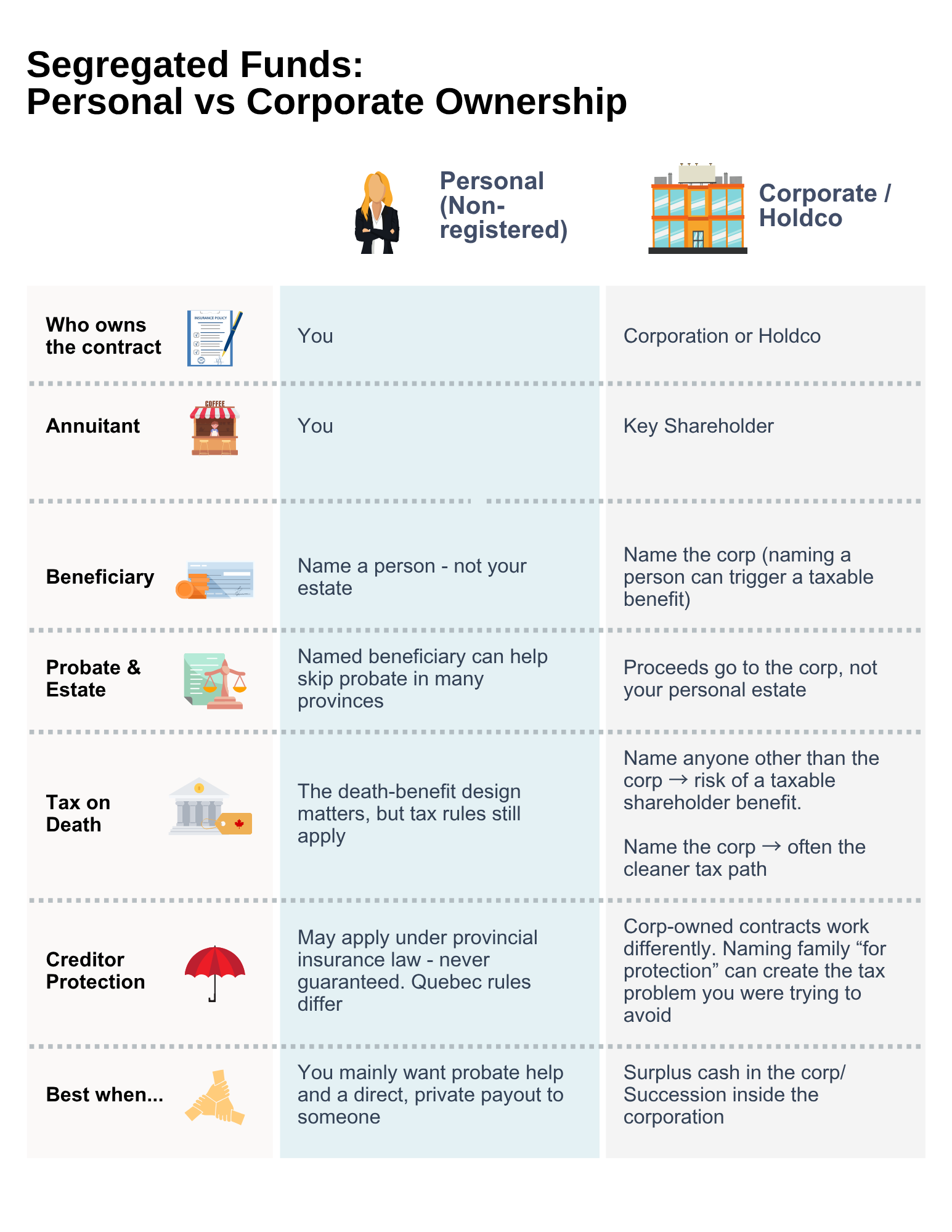
Getting the owner, annuitant, and beneficiary right is as important as choosing the investments. The chart below compares personal and corporate ownership on each of these, plus probate, tax on death, and creditor protection.
On a personally owned, non-registered contract, naming a beneficiary other than your estate can let the death benefit pay directly to that person. In many provinces, this can help bypass probate on that payout. It does not work in every case, and provincial rules differ. Ontario, for example, charges Estate Administration Tax when an estate certificate is issued, so keeping eligible insurance proceeds outside the estate can matter.
Creditor protection may also apply under provincial insurance law, depending on the beneficiary and your circumstances. Quebec follows different Civil Code rules, and protection is never guaranteed.
Some business owners hold segregated funds inside a holding company (Holdco). That can fit when surplus cash already sits in the company, when you want investment returns taxed inside the corporation, or when you are coordinating corporate wealth with a succession plan.
Why a Holdco instead of the operating company?
Many owners use a Holdco to keep surplus investments out of the operating company (Opco). For the lifetime capital gains exemption on a sale, Opco generally needs 90% or more of its assets (by value) in active business use in Canada at the sale, and more than 50% over the prior 24 months. During those 24 months, the shares also generally must not have been owned by anyone other than you or a related person. Moving surplus to a Holdco, often through intercorporate dividends that can usually be received tax-free when the companies are connected, may help, depending on how your shares are held.
A Holdco does not usually avoid the passive income rules. Once investment income tops $50,000 a year, Opco's access to the small business rate shrinks, ending at $150,000. Holdco and Opco are usually associated, so their investment income is combined for this test. Anti-avoidance rules can also apply, so talk to your accountant.
How a corporate contract is usually set up:
When the corporation is the beneficiary, the proceeds return to the company, and later distributions to shareholders follow corporate and tax rules.
If your main goal is probate bypass and a direct, private payout to a person, personal ownership is often the simpler route. Corporate ownership may still make sense when the beneficiary and tax effects are planned in advance. Outcomes are fact-specific, and nothing here promises a tax result or creditor protection.
Whether owned personally or through a Holdco, segregated funds can complement permanent life insurance rather than replace it. Life insurance suits lifelong needs such as taxes that can arise at death (often from deemed dispositions and capital gains), succession liquidity, and buy-sell funding. Many owners use both: life insurance for the large, planned cash need at death, and segregated funds for a portion of non-registered wealth where resets and estate transfer features matter.
This content is provided for general informational purposes only. It is not intended to provide investment, tax, or legal advice, and should not be relied upon as such.